Kensington North Watersheds

  • Kensington North Watersheds Association Receives Funding to Monitor River Otters

    KNWSA is pleased to announce we have received funding through the Wildlife Conservation Fund (WCF) to monitor river otter populations in our area. It may come as a surprise to hear that there is a river otter population on PEI, as most people would never have seen an otter here. That is because river otters have, until recently, been extirpated (locally extinct) from PEI.

    Over the last few hundred years populations of mammals on PEI have changed considerably. For example, PEI used to have populations of black bear, lynx, and even caribou! During the 19th century, river otter fur was very valuable, and this caused the population to be under high pressure from trapping. By the end of the 19th century, records suggest river otters were either very scarce or already gone from the Island.

    Recently, there have been several otter sightings on PEI, including some accidental trappings. Last year Kensington North partnered with PEI Forests, Fish, and Wildlife to monitor otters with the use of remote cameras, also known as trail cameras. This year with the funding received from WCF, we are able to purchase several more remote cameras to expand our monitoring efforts!

    River otters captured using remote trail camera

    The new remote cameras will be set up in various habitats where river otters may be present. These cameras have a passive infra-red sensor which can detect a temperature differential when a heat source, such as an animal, moves in front of the sensor. When the sensor is triggered, the camera takes a picture of the animal in front of it.

    The main goals of our monitoring project are to determine how widespread and established otter populations are in our area and to develop best management practices for using remote cameras to monitor river otters. While our project focuses on otters, we also get pictures of many other types of wildlife using the same habitat. Remote cameras are a great, minimally invasive way to observe wildlife we may not normally see. If you have any wildlife sightings, whether they were taken with a remote camera or not, you can share them online at www.peinaturetracker.ca.

    This project was funded by the Wildlife Conservation Fund, which provides financial support to groups across PEI working to benefit wildlife and wildlife conservation. The funding for WCF comes from annual conservation fees incorporated into PEI licenses for hunting, angling and trapping, and Conservation Plates purchased for motor vehicles in PEI. If you would like to support more projects like this, consider purchasing a conservation license plate!

  • Your Help is Needed to Monitor Local Bat Populations!

    Bats play a vital role not only in our ecosystems but also in our economies! Because bats eat so many insects, they decrease the need for use of chemical pesticides in agriculture, and they also produce guano (bat droppings) that is rich in nitrogen and can act as a natural fertilizer for lawns and gardens.

    Unfortunately, white-nose syndrome (WNS) ― a deadly disease affecting North America’s bat populations ― has killed up to 99% of bats within specific bat colonies along the east coast. Caused by a fungus that grows on bats during winter hibernation, WNS poses no threat to the health of humans, pets or other animals, but it is responsible for the death of over six million bats across North America.

    As of today, two local bat species ― the little brown myotis and the northern myotis ― are listed federally as endangered due to white-nose syndrome.

    Because bats are nocturnal and spend the winter months hibernating, monitoring them can be challenging. Any sightings reported by the public are extremely beneficial to wildlife biologists and researchers as they can help locate maternity colonies, hibernation sites, and important bat habitat that may otherwise go undetected. If you have seen any bats around, we’d like to hear from you!

    Please call the following numbers to report any local bat sightings, receive guidance on managing bats in buildings, for assistance with any bat-related human health concerns, or for general bat information:

    PEI Fish and Wildlife: 902-368-4683 

    Canadian Wildlife Health Cooperative BAT HOTLINE: 1-833-434-BATS (2287), toll-free

    Other ways you can help out local bat populations are:

    • Avoid cutting down old trees (also known as “snags”) that are still standing
    • Maintain woodlots near bodies of water
    • Avoid displacing bats from their roosts between the beginning of May and the end of September
    • Put up a bat house
    • Consult with a wildlife biologist before filling in an old well
    • Talk to your friends and neighbors about bats!

    This project was made possible thanks to funding from Environment and Climate Change Canada’s Habitat Stewardship Program.

    Photo by David Cody
  • Improving Wildlife Habitat in Branders Pond, Cousins Pond, and Paynters Creek with Help from the Wildlife Conservation Fund

    This field season Kensington North Watersheds Association has been working in Branders Pond, Cousins Pond, and Paynters Creek watersheds as part of a project funded by the Wildlife Conservation Fund. The purpose of our project is to improve wildlife habitat including both habitat for terrestrial and aquatic wildlife, and to create and protect biodiversity in these watersheds. 

    Some of the work already completed this year includes working in the streams to remove fallen trees and clean up any damage caused by Hurricane Dorian. Many trees fell down in our watersheds during the hurricane, and while some woody debris in streams is beneficial for fish, too many branches can trap debris and sediment. Staff work with handsaws and chainsaws to remove low hanging branches or logs that are catching debris or look like they could cause issues in the future.  We’ve also begun performing stream and riparian health assessments to better gauge the current state of the watersheds and provide guidance for our restoration work in the future. 

    Over the rest of the field season, we will continue performing stream work, such as clearing debris and nuisance branches and building brush mats as required. In the fall, we plan to plant a variety of native trees and shrubs along these streams in areas that require more tree cover or plant biodiversity.

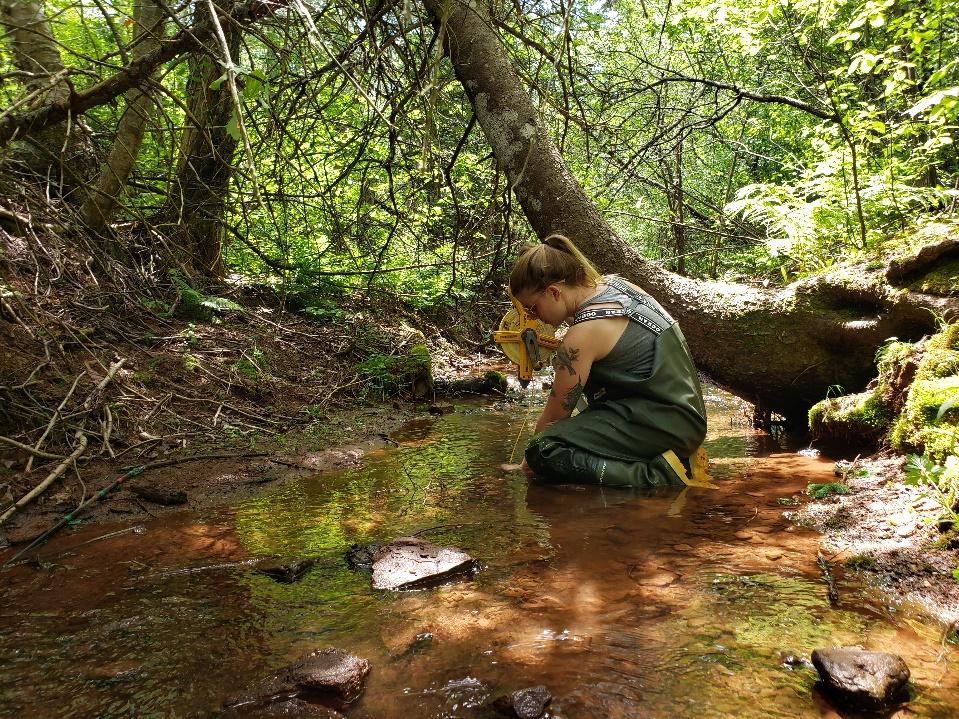
    Kensington North staff member performing a stream health assessment in the Adams Creek system of Paynters Creek watershed.

    Funding from the Wildlife Conservation Fund comes from annual angling, hunting, and trapping licenses, as well as the purchase of motor vehicle conservation plates. Motor vehicle conservation plates are available for a $10 annual fee, with 100% of the fees going toward the Wildlife Conservation Fund. If you are interested in supporting projects like ours, which work to protect and enhance wildlife and wildlife habitats on PEI, please consider purchasing a conservation plate!


    Published in The County Line Courier  Vol. 28, No. 15, Pg. 11

  • WCF Helps Improve Habitat in Spring Valley Brook & Indian River Watersheds

    The PEI Wildlife Conservation Fund provides funding to groups across PEI for the protection and enhancement of wildlife and wildlife habitat. The funds from the Wildlife Conservation Fund come from annual license fees for hunters, anglers, and trappers, as well as the sale of conservation license plates. This year Kensington North Watersheds Association received funding from the PEI Wildlife Conservation Fund for a project to improve habitat in two of our major watersheds, Spring Valley Brook and Indian River.

    The activities performed as part of our project included planting approximately 600 native trees and shrubs along our riparian zones, removing nuisance debris and fallen trees both during the summer and again after Hurricane Dorian, and constructing brush mats. These activities will help improve riparian habitat and benefit the wildlife that live there.

    By planting trees, we are increasing the shade in our riparian zones, helping stabilize the banks and preventing soil erosion, and providing more plant biodiversity for wildlife to feed on and live in. Removing excess debris and branches helps flush sediment and allows steams to flow at a more natural velocity. We also constructed brush mats by placing and securing spruce and fir boughs at strategic locations along stream banks. These structures will catch excess sediment suspended in the water during high flows, allowing the sediment to settle out on the bank instead of in the stream channel. By removing this excess sediment, we hope to maintain a rocky stream bottom in the areas where we already have it, and expose previously buried rocky bottoms in other areas of the stream. This rocky stream bottom not only provides habitat for aquatic insects, which are an important food source for brook trout, but it is also required for brook trout spawning!

    Kensington North would like to thank the PEI Wildlife Conservation Fund for supporting us on this project, and we would like to encourage Islanders to consider purchasing a conservation license plate to help fund similar projects like this and help protect wildlife across PEI!


    Published in The County Line Courier, Vol. 27, No. 23, Pg. 19.

  • Household Hazardous Waste Recap

    Recently, Kensington North Watersheds Association has been reaching out to households, local businesses, and the agricultural community to raise awareness on the risks of hazardous waste and encourage proper disposal. We released a series of articles on hazardous wastes describing everything from what hazardous wastes are and how to get rid of them, to how to make your own safe and “greener” alternative cleaners. This article will serve as an overview on all things hazardous waste, in case you missed any previous articles, or you need a refresher!

    Household hazardous wastes are leftover, or unwanted household products that are either flammable, explosive/reactive, corrosive, and/or toxic. Common and well-known examples of these include old paints (even old paint cans, as they still have paint residue), automotive products like motor oil and oil filters, and fertilizers or pesticides for your lawn and garden. However, there are many more inconspicuous hazards that we use everyday. These include household cleaners, laundry products, cosmetics, and even personal care items like our shampoos, lotions, and deodorants. The important thing to note is that most of these products are only considered hazardous wastes if there is any leftover amount of product that you no longer want. If you use your products to completion, most of them can simply be rinsed and then thrown out according to the packaging (for example, recycled if metal or #1-5, waste if #6).

    It’s important to dispose of our hazardous wastes correctly; therefore, we shouldn’t pour hazardous products down the drain or flush them down the toilet. Our household septic systems and town wastewater treatment facilities are designed to treat biological waste, not hazardous waste. This means the hazardous chemicals could pass right through the system untreated and get released back into our ground and surface water. The same is true for throwing hazardous waste out into our regular waste carts. When garbage is taken to the landfill, it slowly breaks down and forms a liquid called leachate. Leachate is treated and eventually released back into our water, but these systems are not designed to treat hazardous chemicals that might be in the leachate.

    So, what do you do with your hazardous wastes? Take them to a Waste Watch Drop-off Centre (WWDC)! There are six locations on PEI, the closest to Kensington being New London. All WWDC accept household hazardous wastes for free, and will dispose of them in a safe manner. Although it would be convenient to collect these products curbside, due to their hazardous nature it would not be safe and would be very costly. However, there’s plenty of reasons to take your special disposal items to a WWDC. Besides being able to drop off your hazardous wastes, you can also drop off old tires, white goods (old refrigerators, stoves, other appliances), TVs, electronics, and more, all for free. For more information on disposal, check out Island Waste Management Corporation’s website at www.iwmc.pe.ca.

    By taking your unwanted, hazardous wastes to an Island WWDC, you’ll be helping divert harmful ingredients from our landfill and protecting our ground and surface water. Not only will this help extend the life of the landfill, but it will ensure we have safe, clean water and soil for years to come. PEI is already the nation’s leader in waste diversion, so let’s keep it that way!


    Published in The County Line Courier, Vol. 27, No. 21, Pg. 07.

  • Hurricane Dorian

    Tropical Storm Dorian hit the island on September 8th and knocked out power for days, and downed hundreds of trees around Kensington. Many of these trees fell into our streams. Our usual mandate requires us to be out of the streams at the end of September in order to let the trout spawn, but this year we had to extend our season into October to clear the channels.

    Even with the deadline extension we had to get extra help from some students from the Holland College Wildlife Conservation program, some employees of the Watershed Alliance, other independent contractors and our previous executive director to chainsaw these trees out of the streams.

    Sadly in our wooded areas we lost some nice trees such as White Pine and Eastern Hemlock which are not very common around this part of the island. Many poplar, red maple, and of course white spruce also came down.

    A White Pine and Red Maple fallen into the Barbara Weit stream.
  • Multitude of Benefits Results from Mixed Pollinator Fields

    Vernon Campbell is a firm believer in the value of pollinator mixes to help promote biodiversity on his Grahams Road farm.

    Pollinator mixes encompass a variety of plant species from a minimum of three and up to twelve typically. Some common plants grown in pollinator mixes include oats, vetches, alfalfa, timothy, clovers, ryegrass, pearl millet, sorghum sudangrass, beans, peas, sunflowers, radish, other mustards and phacelia (pronounced fuh-see-lee-uh). The aim is to promote biodiversity, attract bumblebees and measure potential improvements in soil health all at once?

    These pollinator crops have a variety of different growth patterns, rooting characteristics and life cycles (annual, biennial or perennial), coordinating well to cover bare soil with biomass, which is valuable to help hold nutrients and improve soil structure to prevent compaction and erosion. Pollinator mixes may also help to break up or alleviate stress from pests in crop rotations by disturbing their habitat in alternative years to susceptible crops.

    On Campbell’s farm, there are seven pollinator species planted including oats, timothy, alsike clover, red clover, yellow blossom sweet clover, birdsfoot trefoil and phacelia.

    After the first season of establishing pollinator mixes, those including annual plants like oats will die down, but other species are biennial or perennial plants like clovers, which will survive at least a second year. There is no management of the mix intended; as it should be left undisturbed to grow for at least another year. Being low maintenance makes pollinator mixes attractive to farmers.

    “When I saw a field planted in pollinator mix, it was full of bumblebees, and it inspired me to plant me as well”, said Campbell who operates Mull Na Bienne Farm Ltd. with his wife, Bertha.

    There is a pollinator mix sign in the field next to his farm, which you see as you drive by Grahams Road on Highway 8. The project is done in collaboration with the PEI Potato Board, the Agronomy Initiative for Marketable Yields (AIM) and the Kensington North Watersheds Association.


    Published in The County Line Courier, Vol. 27, No. 19, Pg. 06.

  • Summertime Household Hazardous Waste Reminder

    Summer is officially here on PEI, and a major part of any PEI summer is spending time outdoors. We may not think of it, but many of the outdoor activities we participate in over the summer require the use of hazardous products, and need special attention when it comes to waste disposal.

    Since many of the products we use for common summer activities may be considered hazardous if they’re no longer used, they should be disposed of correctly and not poured out or thrown in the garbage. For example, sunscreen and bug spray are summertime essentials and provide us with much needed protection from the elements and pests, but leftover or expired products should be taken to a waste watch drop-off centre for proper disposal.

    Many of us also take great pride in our lawns and gardens over the summer and may use household gardening products, such as fertilizers or pesticides. Any leftover household gardening products should also be taken to a waste watch drop-off centre. Going on a camping trip or firing up the barbeque? You can take your empty propane tanks under 30 lbs to either a waste watch drop-off centre or your local propane dealer, whereas propane tanks above 30 lbs only go to your local propane dealer! Finally, if you celebrate an occasion with fireworks and have any leftover, these should NOT be taken to a waste watch drop-off centre, instead you should contact your local police regarding safe disposal.

    There are six waste watch drop-off centres on PEI which accept household hazardous wastes free of charge. Two of these facilities, Wellington and New London, have extended summer hours to account for the busy tourism season. A full list of these facilities and their hours is available on Island Waste Management Corporation’s website at www.iwmc.pe.ca.

    Enjoying time outside with friends and family is central to a PEI summer, but it’s important to ensure that you dispose of the waste properly. Please do your part to protect our groundwater and natural environment for future generations to enjoy by properly disposing of your household hazardous waste!

    Heather Harris,
    Project Coordinator


    Published in The County Line Courier, Vol. 27, No. 14, Pg. 15.

  • DIY Product Alternatives

    In previous articles in our hazardous waste series, we’ve discussed what makes a product a hazardous waste, how to properly dispose of them, the environmental impacts of improperly disposed waste, and discussed resources for learning more about products in your home. This article is the fourth and final article in the series, and we will discuss simpler, DIY alternatives for certain products.

    In our household hazardous waste survey, we asked whether households would be interested in environmentally safer product alternatives. The majority of responses said yes, followed by unsure, and very few households said no. Some that said they were unsure indicated it depends on whether the products worked and how much they cost. Well, we’ve searched the internet, tried various recipes, and have compiled a few methods that we think work just as well as store-bought products and are cost effective. In fact, DIY recipes tend to be cheaper than store-bought cleaners! These recipes and the instructions for their use are listed below.

    Dishwasher Detergent
    1. Place dirty dishes in dishwasher as usual
    2. Add 3 drops of regular dish soap to the dishwasher detergent cup
    3. Fill the cup 2/3 full with baking soda
    4. Add salt until the cup is nearly full
    5. Run dishwasher as normal
    Shower Cleaner

    (works on the worst accumulation of soap scum)

    1. Heat 1 cup of white vinegar in microwave
    2. Add 1 cup dawn dish soap (can use a little less)
    3. Whisk together and put in spray bottle
    4. Spray on shower surfaces and leave to sit
    5. Wipe and rinse well
    Window and Glass Cleaner
    1. 1 part distilled water
    2. 1 part white vinegar
    3. Mix together and add to spray bottle
    4. Spray on surface and wipe clean
    All-purpose Cleaner

    (same recipe as window and glass cleaner above)

    1. 1 part distilled water
    2. 1 part white vinegar
    3. Mix together and add to spray bottle
    4. If you need extra abrasiveness, mix baking soda and water to form paste
    5. Scrub first with baking soda paste, wipe clean, then use all-purpose mix

    We encourage you to also try out these recipes or others you may find on the Internet. If you try any of these recipes out or have a different recipe than the ones we’ve listed, feel free to share them with us by email to KensingtonNorthWatershed @gmail.com, on Facebook at Kensington North Watersheds Association or on Instagram at Kensington_north_watersheds

    This series has been part of Kensington North’s Hazardous Wastes Stewardship Pilot Project which we partnered on with Environment and Climate Change Canada.

    Heather Harris,
    Project Coordinator


    Published in The County Line Courier, Vol. 27, No. 09, Pg. 04.

  • What’s in Your Everyday Household Cleaners?

    In previous articles in our hazardous waste series, we’ve discussed what household hazardous wastes are, how to dispose of them properly, and the impacts of improper disposal. In article three, we’ll be discussing some of the unknowingly harmful ingredients lurking in everyday items in our household!

    Nowadays, when we go to the cleaning aisle of a grocery store, there’s an overwhelming abundance of household cleaners, seemingly for every task imaginable! There are cleaners for the kitchen, stove top, bathroom tiles, toilet bowl, and the list goes on. Many of us likely have a shelf or cupboard filled with these various products that we only touch a few times each year, but have you ever stopped to think about what’s in them?

    If you go to your product cupboard and grab a few, you may be surprised to see that many have no ingredient list on the back. The reason for this? Cleaning product companies are not required to list all of their ingredients and finding them out can be surprisingly difficult. However, there is a very helpful resource online we’ve discovered at www.ewg.org. EWG stands for the Environmental Working Group, which is a US based non-profit organization that focuses on human health and the environment. They have several very informative databases that you can search through, including a database for cleaners, cosmetics, and even sunscreens!

    On their cleaner database you can search through over 2,500 products, where they’ve scored every cleaner with a grade A-F based on their transparency and ingredients. For each product there’s a breakdown of their hazard level for different categories such as asthma/respiratory, skin allergies and irritation, and the environment. Additionally, you can see whether that product has been green-certified, and how good their ingredient disclosure is. EWG has also put together lists of all the known ingredients they could find for each product, but due to companies not having to disclose the ingredients, these lists are not always exhaustive. On these ingredient lists, each ingredient also has a grade A-F and you can click on each ingredient to learn more about their impacts!

    Searching through various cleaning products on EWG’s website has been eye-opening for us. It’s interesting to see how marketing can be misleading, with some products putting spins on the word “organic”, “clean”, and “natural”, only to score rather poorly and have ingredients with health and environmental concerns! This practice is known as “greenwashing”.

    Additionally, some ingredients have us scratching our heads, wondering why they’re even included in the first place. Fragrance, for example, is listed as an environmental concern, a skin allergy concern, and a respiratory concern, and it has been added to over 1,500 products on their list. It’s understandable that we may want our freshly washed laundry to smell nice when it comes out of the wash, but is it really necessary for our dishwashing liquid to smell like apple blossoms or citrus?

    Now, we aren’t saying to empty your cupboards and throw out every single household cleaner you have, but rather to take a look at this website and educate yourself on these products and labels. Then, next time you’re in the cleaning aisle of a grocery store, reconsider if it’s necessary to purchase a different cleaner for every surface or consider a better scoring product alternative! Ultimately, the more educated and knowledgeable we are on the products and hazards in our homes, the better we can make informed decisions on the issues that matter to us.

    Heather Harris,
    Project Coordinator


    Published in The County Line Courier, Vol. 27, No. 08, Pg. 04.